
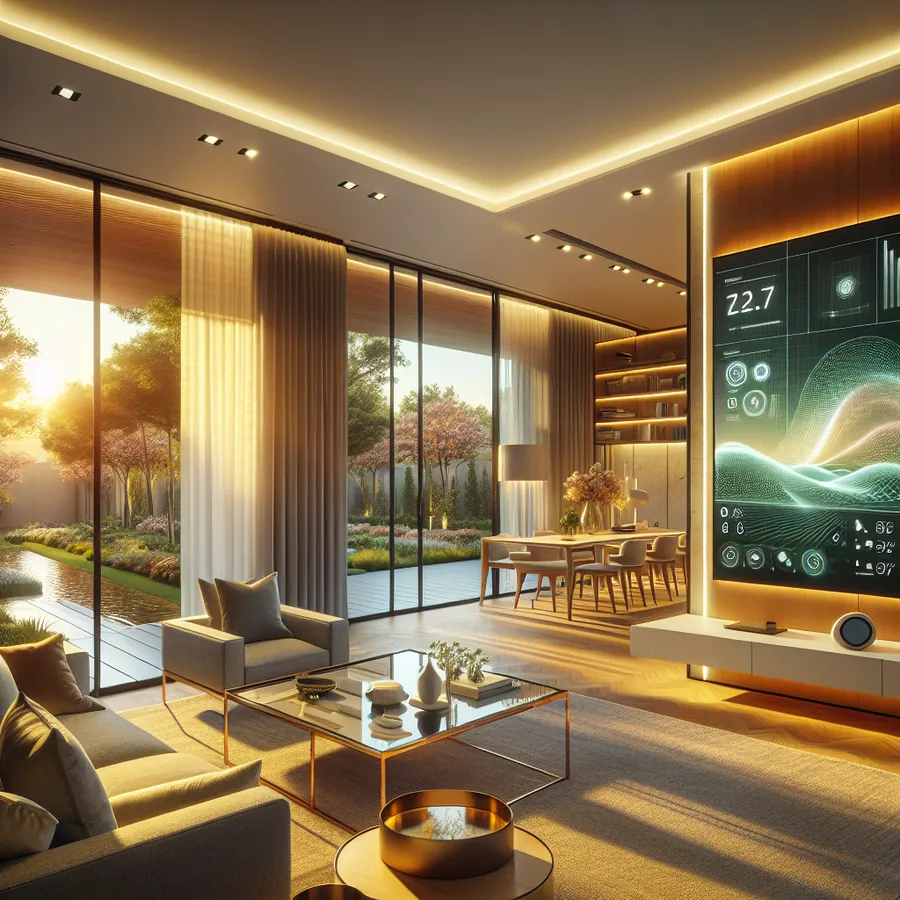
AI Energy Management Platforms 2027 Outlook: The Complete Integration Guide for Smart Homeowners
Imagine waking up to a home that has already optimized its energy consumption overnight, negotiated the best electricity rates while you slept, and preheated your bathroom to the perfect temperature—all while reducing your carbon footprint by 40%. This isn't science fiction. By 2027, AI energy management platforms will transform how we interact with our homes, and the revolution is already underway.
As certified Lutron HomeWorks dealers with years of experience integrating cutting-edge automation systems, we at IxomeAI have watched the energy management landscape evolve from simple programmable thermostats to sophisticated AI-driven ecosystems. The 2027 outlook isn't just promising—it's transformative. Let's dive deep into what's coming, what's already here, and how you can position your smart home for the future.
The Current State of AI Energy Management
Today's AI energy management platforms have moved far beyond basic scheduling. They're learning machines that understand your patterns, predict your needs, and make real-time decisions that balance comfort with efficiency. The market has matured significantly, with major players establishing clear differentiation strategies.
What makes 2027 particularly exciting is the convergence of several technologies: advanced machine learning algorithms, ubiquitous IoT sensors, grid-interactive capabilities, and—perhaps most importantly—the standardization of communication protocols that finally allow disparate systems to work together seamlessly.
Platform Compatibility Matrix: 2024-2027
Understanding which platforms work with your existing infrastructure is crucial. Here's our comprehensive compatibility breakdown:
Major AI Energy Platforms
| Platform | Lutron HomeWorks | Control4 | Crestron | KNX | Matter Support | Grid Services | Est. 2027 Features |
|---|---|---|---|---|---|---|---|
| Google Nest Renew Pro | Full | Full | Full | Partial | Native | Yes | Predictive grid arbitrage |
| Amazon Hive Energy | Full | Full | Full | Full | Native | Yes | Whole-home digital twin |
| Apple Home Energy | Full | Partial | Partial | Limited | Native | Limited | Privacy-first local AI |
| Schneider Wiser 3.0 | Full | Full | Full | Native | Native | Yes | Industrial-grade analytics |
| Span Panel AI | Full | Full | Full | Via gateway | Native | Yes | Circuit-level optimization |
| Savant Power System | Native | Full | Full | Via gateway | Coming 2026 | Yes | Luxury integration focus |
HVAC System Integration
| HVAC Brand | AI Platform Compatibility | Deep Integration | Predictive Maintenance | 2027 Roadmap |
|---|---|---|---|---|
| Carrier Infinity | All major platforms | Yes | Yes | Full AI autonomy |
| Trane ComfortLink | All major platforms | Yes | Yes | Grid-responsive cooling |
| Daikin One+ | All major platforms | Yes | Yes | VRF optimization AI |
| Mitsubishi kumo cloud | Most platforms | Partial | Coming 2026 | Zone-level learning |
| LG ThinQ | Most platforms | Yes | Yes | Multi-split coordination |
Solar & Battery Systems
| System | AI Platform Support | Vehicle-to-Home | Storm Prediction | Arbitrage Ready |
|---|---|---|---|---|
| Tesla Powerwall 3 | Full | Yes | Yes | Yes |
| Enphase IQ 10 | Full | Coming 2026 | Yes | Yes |
| SolarEdge Home | Full | Yes | Yes | Yes |
| Generac PWRcell | Full | Limited | Yes | Yes |
| Sonnen ecoLinx | Full | Yes | Yes | Premium |
Step-by-Step Integration Guide
Whether you're starting fresh or upgrading an existing system, here's how to build a future-proof AI energy management ecosystem:
Phase 1: Foundation Assessment (Week 1-2)
Step 1: Audit Your Current Infrastructure
Before adding any AI layer, document what you have. Create an inventory of:
- All connected devices and their protocols (Zigbee, Z-Wave, Wi-Fi, proprietary)
- Your electrical panel capacity and available circuits
- Existing automation systems (this is where HomeWorks expertise becomes invaluable)
- Internet bandwidth and network architecture
Step 2: Establish Your Energy Baseline
Install whole-home energy monitoring if you haven't already. The Sense Energy Monitor or Emporia Vue provide circuit-level insights that AI platforms need for optimization. Run this for at least two weeks before proceeding.
Step 3: Define Your Goals
Are you optimizing for cost savings, carbon reduction, resilience, or comfort? Most homeowners want all four, but understanding your priorities helps configure AI decision-making appropriately.
Phase 2: Core System Installation (Week 3-6)
Step 4: Choose Your Primary AI Platform
Based on our compatibility tables and your existing ecosystem, select a platform. For Lutron HomeWorks installations—which we specialize in—we typically recommend either Savant Power System for ultra-luxury applications or Schneider Wiser 3.0 for maximum analytical depth.
Step 5: Install Smart Electrical Infrastructure
Consider upgrading to a smart electrical panel like Span or Lumin. These provide:
- Individual circuit control
- Real-time consumption data
- Automatic load shedding during outages
- Foundation for future AI optimization
Step 6: Integrate Your Lighting System
Lighting represents 10-15% of home energy use. A properly configured HomeWorks system doesn't just dim lights—it coordinates with occupancy sensors, daylight harvesting, and your AI platform to optimize every watt. Our community thread on advanced HomeWorks energy scenes covers this in detail.
Phase 3: AI Layer Configuration (Week 7-10)
Step 7: Connect All Systems to Your AI Platform
Using Matter protocol where available (increasingly standard by 2027), connect:
- HVAC systems
- Lighting controls
- Window treatments
- Pool/spa equipment
- EV chargers
- Solar/battery systems
Step 8: Configure Learning Parameters
Most AI platforms need 2-4 weeks to learn your patterns. During this period:
- Maintain relatively normal routines
- Manually override when needed (the AI learns from this)
- Review weekly reports and adjust comfort boundaries
Step 9: Enable Grid Services
If your utility offers demand response programs, enroll your AI platform. By 2027, these programs will become significantly more lucrative as grid operators increasingly rely on distributed energy resources.
Phase 4: Advanced Optimization (Ongoing)
Step 10: Implement Predictive Strategies
Once your AI has baseline data, enable advanced features:
- Weather-predictive pre-conditioning
- Time-of-use rate optimization
- Solar production forecasting
- Occupancy prediction
For detailed configuration walkthroughs, check our AI platform setup guides in the community forum.
The 2027 Horizon: What's Coming
The next three years will bring transformative changes to AI energy management. Here's what our industry analysis suggests:
Autonomous Grid Participation
By 2027, your home's AI won't just respond to utility signals—it will actively participate in energy markets. Imagine your battery system automatically buying electricity at 2 AM when prices dip to $0.03/kWh, then selling back to the grid at 6 PM when prices spike to $0.45/kWh. Early adopters are already seeing 30-50% reductions in net energy costs.
Digital Twin Technology
AI platforms will maintain complete virtual models of your home, simulating thousands of scenarios to find optimal configurations. "What if we replaced the west-facing windows?" Your AI will model the energy impact before you spend a dime.
Predictive Maintenance Revolution
Your HVAC system won't fail unexpectedly. AI analysis of motor vibration patterns, refrigerant pressures, and energy consumption curves will predict failures weeks in advance. We're already seeing this with premium systems, but by 2027, it'll be standard.
Hyper-Personalized Comfort
Forget zone-based climate control. AI will track individual family members (with consent) and adjust micro-environments in real-time. The living room will be 72°F when you're reading and 68°F when you're exercising—automatically.
Carbon-Aware Computing
Your home AI will know when the grid is running on clean energy versus fossil fuels, scheduling high-consumption activities (EV charging, water heating, laundry) during green periods. For environmentally conscious homeowners, this is a game-changer.
Integration with Luxury Automation Systems
For those with premium automation platforms like Lutron HomeWorks, the 2027 outlook is particularly exciting. HomeWorks' reliability and precision make it an ideal foundation for AI energy management. The system's granular control over every circuit, combined with its rock-solid reliability, provides the perfect substrate for AI optimization.
As authorized HomeWorks dealers, we've been working with beta versions of upcoming integrations that allow AI platforms to leverage HomeWorks' scene architecture for energy optimization. The results are impressive—one client saw a 34% reduction in lighting energy use with zero perceived change in ambiance.
Our HomeWorks and AI integration thread has extensive discussion from early adopters.
Frequently Asked Questions
Q: Will AI energy management work with my older home?
A: Absolutely. While newer homes with smart panels have advantages, AI platforms can optimize any home with basic smart devices. Start with smart thermostats and lighting, then expand. The key is choosing a platform with broad compatibility.
Q: How much can I realistically save with AI energy management?
A: Based on our client data, typical savings range from 15-35% on energy costs, with some achieving 50%+ when combining solar, battery storage, and time-of-use optimization. The exact figure depends on your utility rates, climate, and home characteristics.
Q: Is my data safe with these AI platforms?
A: This varies significantly by platform. Apple's approach keeps data local, while others rely on cloud processing. We recommend reviewing privacy policies carefully and choosing platforms that offer local processing options where possible.
Q: Do I need solar panels for AI energy management to make sense?
A: No. While solar amplifies benefits, AI optimization provides significant value through load shifting, demand response participation, and efficiency improvements alone. Solar simply adds another optimization dimension.
Q: How long until these systems pay for themselves?
A: For a typical installation, we see payback periods of 2-4 years. Homes with solar, battery storage, and variable utility rates often see faster returns. By 2027, as grid services become more valuable, payback periods should decrease further.
Q: Can I install this myself or do I need a professional?
A: Basic smart devices can be DIY, but for comprehensive AI energy management—especially with premium systems like HomeWorks—professional installation ensures optimal configuration and integration. The complexity isn't in the physical installation but in the system architecture and programming.
Your Next Steps
The 2027 AI energy management landscape will reward early adopters. Systems installed today will have years of learning data, making them significantly more effective than newly installed systems. The question isn't whether to adopt AI energy management—it's how quickly you can get started.
Not sure where to begin? Chat with our AI agent for a tailored setup recommendation based on your specific home, existing systems, and goals. Our agent can analyze your situation and suggest the optimal path forward, whether you're starting from scratch or upgrading an existing smart home.
The future of home energy is intelligent, autonomous, and remarkably efficient. Let's build it together.
