
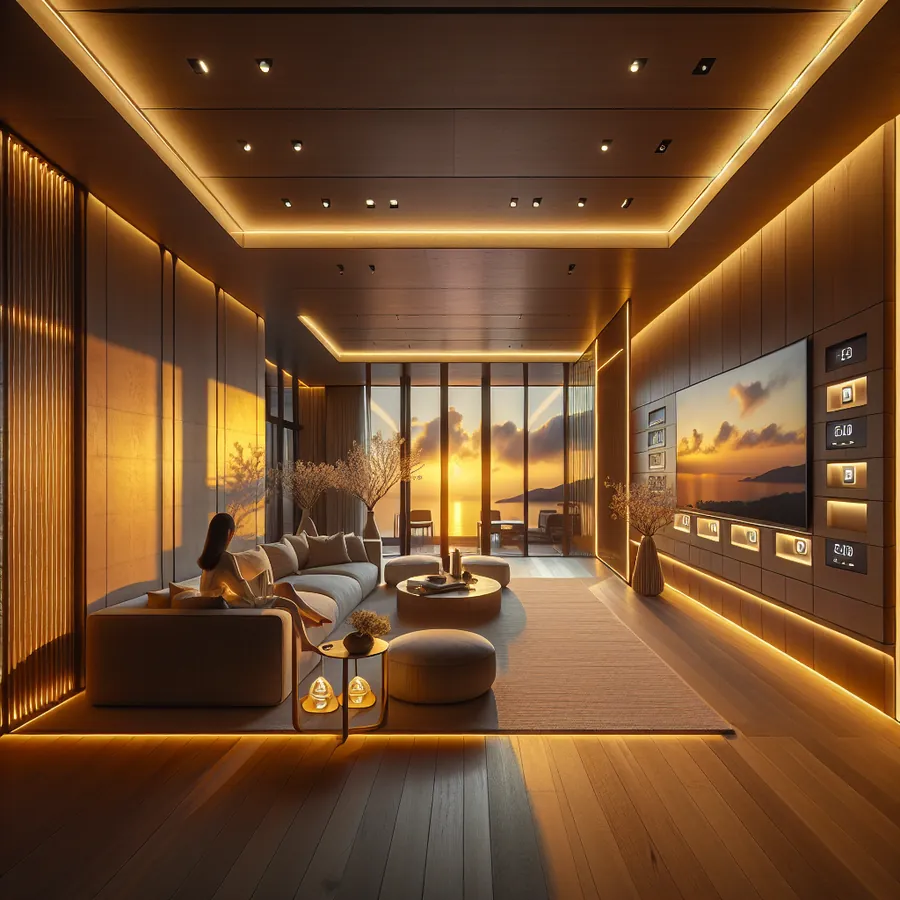
Smart Home Wellness Lighting Science 2026: The Complete Guide to Circadian-Optimized Living
Imagine waking up to a gentle sunrise simulation that perfectly mimics the golden hues of dawn, your body naturally transitioning from deep sleep to alert wakefulness without the jarring assault of an alarm clock. By midday, your home bathes you in crisp, energizing light that keeps your cognitive performance at peak levels. As evening approaches, warm amber tones gradually envelop your space, signaling to your brain that it's time to wind down. This isn't science fiction—it's the reality of wellness lighting science in 2026, and it's transforming how we live, sleep, and thrive.
The convergence of chronobiology research, advanced LED technology, and sophisticated smart home integration has created an unprecedented opportunity to optimize our living environments for health. As certified Lutron HomeWorks dealers, we at IxomeAI have witnessed firsthand how proper lighting implementation can dramatically improve sleep quality, boost productivity, and enhance overall wellbeing. Let's dive deep into the science and practical applications that are defining wellness lighting in 2026.
Understanding Circadian Rhythms
Your circadian rhythm is essentially your body's internal 24-hour clock, governed primarily by the suprachiasmatic nucleus (SCN) in your brain. This master clock regulates everything from hormone production to body temperature, and light is its primary synchronization signal.
Research published in the Journal of Biological Rhythms (2025) demonstrated that exposure to appropriate light spectrums at specific times can:
- Improve sleep efficiency by up to 23%
- Reduce cortisol awakening response irregularities
- Enhance melatonin production timing by 45 minutes on average
- Boost daytime alertness scores by 18%
The Melanopic Lux Revolution
Traditional lux measurements only tell part of the story. In 2026, the industry standard has shifted to melanopic equivalent daylight illuminance (M-EDI), which specifically measures light's impact on the intrinsically photosensitive retinal ganglion cells (ipRGCs) responsible for circadian entrainment.
The WELL Building Standard v3 now recommends:
- Morning (6-10 AM): 250+ melanopic lux
- Midday (10 AM-3 PM): 300+ melanopic lux
- Evening (after 6 PM): Below 50 melanopic lux
Wellness Lighting System Compatibility Guide
Choosing the right ecosystem is crucial for achieving true wellness lighting integration. Here's our comprehensive compatibility analysis:
Primary Control Systems
| System | Tunable White Support | Circadian Automation | Voice Control | Professional Installation | Wellness Score |
|---|---|---|---|---|---|
| Lutron HomeWorks QSX | Excellent | Native | Full | Required | ★★★★★ |
| Lutron RadioRA 3 | Excellent | Native | Full | Recommended | ★★★★★ |
| Control4 OS 3 | Excellent | Via Programming | Full | Required | ★★★★☆ |
| Savant | Excellent | Native | Full | Required | ★★★★☆ |
| Crestron Home | Excellent | Via Programming | Full | Required | ★★★★☆ |
| KNX | Excellent | Via Logic | Limited | Required | ★★★★☆ |
| Philips Hue Pro | Good | App-Based | Full | DIY Possible | ★★★☆☆ |
Tunable White Fixture Compatibility
| Fixture Brand | CCT Range | CRI Rating | HomeWorks Integration | RadioRA 3 Integration |
|---|---|---|---|---|
| Ketra | 1400K-10000K | 95+ | Native | Native |
| USAI Lighting | 2200K-6500K | 90+ | Excellent | Excellent |
| Lutron Ivalo | 2700K-6500K | 90+ | Native | Native |
| DMF Lighting | 2700K-5000K | 90+ | Good | Good |
| WAC Lighting | 2700K-5000K | 90+ | Good | Good |
| Philips Hue | 2000K-6500K | 80+ | Via Integration | Via Integration |
For detailed discussions on specific fixture pairings, check out our IxomeAI community thread on Ketra vs. traditional tunable white solutions.
Phase 1: Assessment and Planning
Step 1: Conduct a Lifestyle Analysis
Before selecting any equipment, document your household's daily patterns:
- Wake times for each family member
- Work-from-home schedules
- Exercise routines
- Typical bedtimes
- Any existing sleep or mood concerns
Step 2: Room-by-Room Light Audit
Using a spectrophotometer (or consulting with your HomeWorks dealer), measure:
- Current melanopic lux levels throughout the day
- Color temperature of existing fixtures
- Natural light availability by room and time
Step 3: Define Wellness Zones
Categorize spaces by their primary circadian function:
- Activation Zones: Kitchen, home office, gym
- Transition Zones: Living room, dining room
- Relaxation Zones: Bedrooms, media rooms
Phase 2: System Design
Step 4: Select Your Control Platform
For whole-home wellness lighting, we consistently recommend Lutron HomeWorks QSX or RadioRA 3. The native Ketra integration provides unmatched spectral control, and the reliability is simply unparalleled in our twenty-seven years of installation experience.
Step 5: Specify Fixtures by Zone
For each zone, specify fixtures that support:
- Full-range tunable white (minimum 2700K-5000K)
- High CRI (90+ recommended, 95+ ideal)
- Smooth dimming to 1% or below
- Flicker-free operation at all levels
Step 6: Design Scene Sequences
Create time-based scenes that transition throughout the day:
Sunrise Sequence (6:00-7:30 AM)
├── 6:00 AM: 1% @ 2200K (pre-dawn)
├── 6:15 AM: 10% @ 2700K (early dawn)
├── 6:30 AM: 30% @ 3000K (golden hour)
├── 6:45 AM: 50% @ 3500K (morning light)
└── 7:30 AM: 75% @ 4000K (full morning)
Our community has shared numerous scene programming templates in the wellness lighting automation thread.
Phase 3: Installation and Calibration
Step 7: Professional Installation
Wellness lighting systems require precise installation and programming. Work with a certified dealer who understands both the technical requirements and the chronobiology principles.
Step 8: Calibration and Testing
Post-installation calibration should include:
- Fixture output verification with calibrated meters
- Scene transition smoothness testing
- Integration testing with other smart home systems
- User interface training for all household members
Step 9: Two-Week Adjustment Period
Live with the system for two weeks, making notes on:
- Wake quality improvements
- Energy levels throughout the day
- Sleep onset timing
- Any scenes that feel "off"
Machine Learning Meets Chronobiology
The most exciting developments in 2026 involve AI systems that learn and adapt to individual circadian needs. These platforms analyze:
- Wearable sleep data (Oura, WHOOP, Apple Watch)
- Activity patterns from motion sensors
- External factors (weather, season, travel)
- User feedback and manual adjustments
Predictive Circadian Optimization
Next-generation systems like the Lutron Athena platform (currently in beta) use predictive algorithms to:
- Anticipate jet lag and pre-adjust lighting schedules
- Detect early signs of seasonal affective disorder
- Optimize for individual chronotypes (early birds vs. night owls)
- Coordinate with smart thermostats for combined thermal-light optimization
Integration with Health Ecosystems
We're seeing deeper integration between wellness lighting and broader health platforms:
- Apple Health: Automatic scene adjustments based on sleep debt calculations
- Google Fit: Activity-responsive lighting that energizes after sedentary periods
- Medical Devices: Integration with light therapy prescriptions for SAD treatment
Curious about how AI can optimize your specific setup? Chat with our AI agent for tailored recommendations based on your home's unique configuration and your family's wellness goals.
Voice and Gesture Control Evolution
Natural language processing has advanced to understand wellness-specific commands:
- "Hey Google, I have a big presentation tomorrow—optimize my morning lighting"
- "Alexa, I'm feeling sluggish—give me an energy boost"
- "Siri, prepare the house for a restful evening"
Frequently Asked Questions
Q: How much does a whole-home wellness lighting system cost?
A: Entry-level wellness lighting with RadioRA 3 and quality tunable white fixtures typically starts around $15,000-25,000 for a 2,500 sq ft home. Premium installations with HomeWorks QSX and Ketra fixtures range from $50,000-150,000+ depending on home size and complexity. The ROI in terms of health benefits, energy savings, and property value increase makes this a worthwhile investment for most homeowners.
Q: Can I retrofit my existing smart lighting for wellness features?
A: Partially. If you have Lutron systems installed, adding tunable white fixtures and updating programming is straightforward. Philips Hue users can implement basic circadian schedules through the app. However, for true melanopic optimization, purpose-built systems with high-CRI tunable fixtures deliver significantly better results.
Q: How long before I notice health benefits from wellness lighting?
A: Most users report improved sleep quality within 1-2 weeks. Sustained energy improvements and mood stabilization typically emerge over 4-6 weeks as your circadian rhythm fully synchronizes. Some benefits, like reduced seasonal affective symptoms, may take a full seasonal cycle to fully appreciate.
Q: Do wellness lighting systems work with renters or apartments?
A: Yes, though options are more limited. Portable tunable white lamps, smart bulbs in existing fixtures, and light therapy devices can provide meaningful benefits without permanent installation. We discuss renter-friendly solutions in our apartment wellness lighting community thread.
Q: Is wellness lighting safe for children?
A: Absolutely—in fact, children often benefit most from proper circadian lighting. Their developing systems are particularly sensitive to light cues. We recommend slightly earlier evening dimming schedules for children and ensuring bedrooms have complete darkness capability for optimal melatonin production.
Q: How does wellness lighting interact with screen time?
A: Even the best wellness lighting can be undermined by late-night screen exposure. We recommend combining architectural wellness lighting with device-level solutions like Night Shift, blue light filtering glasses, and establishing screen-free wind-down periods. Some advanced systems can automatically trigger "screen time ending" notifications as evening lighting transitions begin.
Conclusion: Investing in Your Biological Infrastructure
Wellness lighting represents one of the most impactful investments you can make in your home's health infrastructure. The science is clear: proper light exposure dramatically influences sleep, mood, cognitive performance, and long-term health outcomes. In 2026, the technology has finally caught up with the research, making true circadian optimization accessible for residential applications.
As HomeWorks-certified dealers with deep expertise in wellness lighting implementation, we've helped hundreds of families transform their homes into health-optimizing environments. The difference between a basic smart lighting installation and a properly designed wellness system is profound—and it's a difference you'll feel every morning when you wake up naturally refreshed.
Whether you're building new, renovating, or looking to upgrade an existing smart home, the path to better health might be as simple as better light.
